
I. Introduction
In this paper, we examine the impact of trade tensions on inflation and output growth across a panel of 36 economies in the Asia-Pacific under complete and incomplete pass-through mechanisms. We hypothesize that under a complete pass-through mechanism, the Asia-Pacific will be non-retaliatory and set prices such that the quantity of trade falls, revenues and production collapse, and aggregate demand diminishes. In contrast, in an incomplete pass-through setting, the region will impose counter-tariffs such that its own exports can boost growth and dampen inflation. The proposed relationship between trade tensions and macroeconomic outcomes is motivated by neoclassical trade theory, which suggests that the impact of tariffs can be either complete or incomplete, depending on the ability of receiving nations to influence prices. Thus, small open economies are expected to be completely impacted since they are price takers, while large open economies can alter the impact given their ability to influence prices (Fajgelbaum et al., 2021).
This hypothesis is important because the growing uncertainty in the global trading environment, particularly following the U.S. “Trump Tariffs” and the ensuing trade disputes with major trading partners such as China and India, has reshaped the dynamics of Asian trade and its macroeconomic position. The current study builds on relevant empirical contributions (see, for example, Caldara et al., 2020; Wu et al., 2025). We focus on the Asia-Pacific region, in contrast to the dominant practice of explaining U.S.-China trade tensions from the perspective of the United States, the Euro Area, or China; thus, we extend our sample to include small open economies with active trade links with the world as well as the U.S. and China. While previous studies have examined the effects of trade uncertainty on selected economies, this paper contributes to the literature by offering insights into the macroeconomic impacts of trade tensions under different assumptions. Specifically, we examine the following two questions: (1) Does the import channel of trade tension transmission differ from the direct transmission channel? (2) Does the export channel of trade tension transmission differ from the direct transmission channel?
We employ annual data from 2000 to 2024 and find that trade tensions (TTs) generally reduce investment, output, and prices when a complete pass-through is assumed. We also find the import channel of TT to be inflationary, while the export channel is significant for output growth when income classes are taken into account and an incomplete pass-through mechanism is assumed. Thus, “Trump Tariffs” amplify and suppress consumer prices and output through different channels, suggesting the need for the region to further improve its trade elasticities. These results pass robustness tests that address the flexibility of the dynamic multivariate panel model, which allows for the hierarchical transmission of shocks.
These findings make important contributions to the literature. First, the import channel of TTs is inflationary; second, the output growth of high-middle-income Asian economies is more negatively exposed to TTs. The results thus vary by the trade transmission channel adopted (i.e., direct vs. indirect) and underscore the importance of these assumptions in understanding the impact of trade tensions under plausible scenarios. Our findings renew the importance of export reorientation, trade complexity, trade openness, financial development, and regional integration in amplifying the effectiveness of the export channel to yield a significant negative impact on trade-induced inflation and improve economic growth.
The remainder of the paper is structured as follows. Section II presents the methodology and data. Section III discusses the empirical results. Section IV concludes with the main findings and policy implications.
II. Methodology
We use a panel of 36 Asia-Pacific economies that account for a significant portion of the region’s gross domestic product. In line with the study’s theoretical background, we use the Bayesian dynamic multivariate panel model (DMPM) recently developed by Helske & Tikka (2024) to examine the direct and indirect impacts (via the import and export channels) of trade tensions on inflation and GDP growth in a panel of Asia-Pacific nations. Seminal contributions from Lerner (1936) hold that trade tariffs and taxes are protectionist because they increase import prices and reduce export prices (i.e., in the wake of retaliations). We augment this causal mechanism with findings from Costinot & Werning (2019), who show that shifting from an export to an import tariff tends to incentivize firms to expand domestic activities, which may lead to trade reallocation and lower connectedness over the long run.
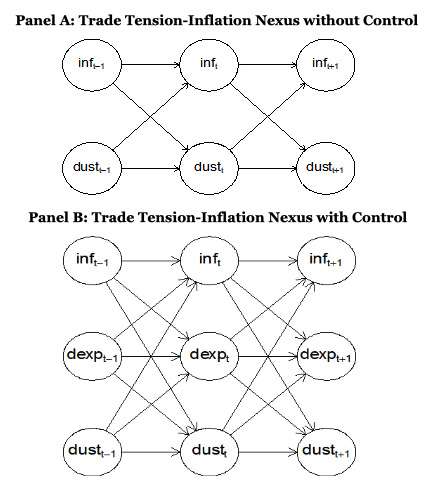
Unlike traditional causal models, DMPM allows for the joint estimation of covariates within a system of equations. In addition, the Bayesian estimation framework allows the model to accommodate multivariate error distributions, contemporaneous correlation, and endogeneity by explicitly modeling the full covariance structure (see Salisu & AbdulHakeem, 2026). Given the structural framework, we first estimate the direct impact of trade tension on macroeconomic outcomes (see Panel A of Figure 1), and we then isolate the impact of the channels by estimating the indirect impact (i.e., via trade volumes) on outcomes (see Panel B of Figure 1), given acyclic dependencies.
The hierarchical model linking trade tension to macroeconomic outcomes such as inflation and GDP growth is defined as follows:
\[\begin{aligned} y_{t,i} & \sim p_{t}\left( y_{t,i} \mid y_{1:t - 1,i},x_{t,i},\theta \right)\\ & \quad = \prod_{c = 1}^{C}\mspace{2mu} p_{c,t}\left( y_{c,t,i} \mid y_{\pi(c),t,i},y_{1:t - 1,i},x_{t,i},\theta \right) \end{aligned}\tag{1}\]
\[i = 1,2,3,\ldots,N;\ t\ = 1,2,\ldots,T\]
is defined as the order of responses (inflation and output growth), which can depend conditionally on past observations, where and also on additional exogenous covariates (i.e., percentage changes in trade tension indices). In addition, each response variable, namely can depend on other observations at the same time point 𝑡. Following Equation (1), the linear predictor for the conditional distribution of each response is defined as:
\[\eta_{c,t,i} = \alpha_{c,t} + u_{c,t,i}^{\top}\beta_{c} + w_{c,t,i}^{\top}\delta_{c,t} + z_{c,t,i}^{\top}\nu_{c,i} + \lambda_{c,i}^{\top}\psi_{c,t}, \tag{2}\]
We define the terms as follows. is the time-varying common intercept term, defines the covariates that are specific to the vector of time-invariant coefficients and similarly defines the covariates for the time-varying coefficients The term corresponds to individual-specific random effects, and the final term is a product of latent individual loadings and a univariate latent dynamic factor
We retain and report estimates of given that trade-tension transmission channels (tariff effects, uncertainty effects, and supply-chain disruptions) are structural and persistent (see Wu et al., 2025). Thus, we assume a time-invariant impact on output and inflation.
We collect annual data on U.S.-related trade policy uncertainties (see Baker et al., 2016; Caldara et al., 2020) and the U.S.-China trade policy uncertainty (Rogers et al., 2024) as proxies for trade tensions from https://www.policyuncertainty.com/. Data on the inflation rate and GDP (current US$ million) were sourced from the IMF webpage[1] and World Bank[2], respectively. Data on total import and export values (current US$ million) were obtained from the World Trade Organization[3]. The scope of the dataset covers the period from 2000 to 2024.
We commence our analysis by estimating the direct impact of trade tensions on macroeconomic outcomes (see Panel A of Figure 1 for a visualization of the specified equation[4]); thereafter, we incorporate both import and export values to understand how both channels behave under trade shocks with respect to inflation and output (see Panel B of Figure 1 for a visualization of the specified equation).
For the robustness check,[5] we also analyze the relationship using the difference and system GMM estimators. The validity of the DMPM model is dependent on the NUTS sampler diagnostics, which must show no divergences, saturated max treedepths, or low Bayesian Fraction of Missing Information (E-BFMIs). In addition, the GMM estimators are acceptable when the AR(1) test is statistically significant, while the AR(2) and Sargan/Hansen’s tests are statistically insignificant (Baltagi, 2021).
.png)
III. Results
A. Descriptive analysis
In Table A1, we report the descriptive statistics of macroeconomic conditions and trade-tension indicators across income groups (see Table A2 for the income classification). High-income economies record the largest average import and export values, which reflect their integration into global trade, alongside relatively low and stable inflation and high GDP. Upper-middle-income countries show comparable mean trade volumes, as indicated by the large coefficients of variation, suggesting strong trade performance. Lower-middle-income economies exhibit markedly smaller average trade flows and GDP, consistent with their smaller economic scale, but their inflation variability is comparatively lower than that of upper-middle-income countries. In sum, the results show increasing volatility in trade and macroeconomic indicators as income levels decline.
B. Main results
We use the dynamic multivariate panel model (see Tables 1–3 and Tables A1–A34 in the Appendix[6]), which accounts for underlying macroeconomic disturbances, to examine the impact of trade tensions on inflation and GDP in the Asia-Pacific. We find that: (1) based on an assumed complete pass-through, trade tensions lead to a reduction in prices (by 0.059% – 0.089%, see inf_tt_lag1 in Table 1) and output growth (by 0.407% – 0.592%, see gy_tt_lag1 in Table 2). (2) U.S. trade tensions matter more for prices compared to U.S.-China trade tensions in this regard. (3) Conditional on the specified DAG causality, the residual pass-through (TT-Import-Outcome) shows that the import channel of trade tension is inflationary (by 0.208%–0.210%, see inf_ctrl_lag1 in Table 1) and more dominant than the export channel in transmitting trade shocks. This effect is consistent across all income classes (see Tables A5–A7).
However, neither channel affects output growth significantly (see gy_ctrl_lag1 in Table 2). It is noteworthy that both the import and export channels exhibit different behaviors when income classes are considered. Specifically, the export channel of TT significantly lowers the output growth of high-income economies by 0.7% – 0.14% (see gy_ctrl_lag1 in Table A9). This effect is weak in middle-income economies (see Table A10). Interestingly, both channels of TT significantly improve the output growth of low-income economies by 0.07% (see gy_ctrl_lag1 in Table A11), suggesting the relative net benefits of high TT for low-income Asian economies with respect to economic growth. (4) Trade tensions significantly dampen both import (by 0.757% – 1.245%, see crtl_tt_lag1, Tables 1 and 2) and export values (by 0.798% – 1.258%, see crtl_tt_lag1, Tables 1 and 2 for the export column), irrespective of the proxies adopted and the outcome being considered. (5) The magnitude of import value reduction due to TTs is more pronounced for the U.S. TT. (6) The magnitude of export value reduction due to TTs is more pronounced for the U.S.-China TT. (7) Importantly, the impact of TTs on the outcome variables is strictly negative using variants of GMM models (see Tables A12–A34), highlighting the superiority of the DMPM in the context of this study.
IV. Conclusion
This study shows that the macroeconomic impact of trade tensions on the Asia-Pacific depends on how shocks are transmitted. When trade tensions pass directly into the domestic economy, the region experiences slower growth and lower prices, consistent with conditions in economies that mainly act as price takers in global markets. However, when transmission occurs through trade channels, the effects become asymmetric: import disruptions generate significant inflationary pressures, while the export channel exerts only weak and statistically insignificant support for price stability. The export channel of TT significantly lowers the output growth of high-middle-income economies and improves the output growth of low-income economies, suggesting that TTs may also offer an opportunity for low-income economies to develop their export markets through improved demand.
Moreover, this imbalance indicates that the region’s current trade structure is limited in offsetting external shocks through export expansion. The findings also suggest that the region remains more vulnerable to unilateral U.S. trade policy than to U.S.-China trade reconfigurations. Together, these findings imply that policy should move beyond general calls for integration. Instead, regional integration efforts should specifically aim to strengthen intra-regional supply chains, upgrade export value addition, and reduce import dependence in key production inputs to enhance the effectiveness of the export channel for high-middle-income Asian economies and improve the region’s resilience to future trade policy shocks.
See https://www.wto.org/english/res_e/statis_e/merch_trade_stat_e.htm
We assume Student’s t-distribution for all the equations since the response variables depict heavier tails than the normal distribution.
The GMM models the Bayesian estimation. However, it cannot accommodate variable interdependence within a single model as demonstrated with the DAG. Also, we can only engage trade volumes in the nexus between TTs and the outcomes (i.e inflation and growth) by controlling for them; connoting that GMMs cannot factorize the response from TTs in an ordered approach. Thus, we included the GMM to serve as a robustness for certain aspects of the main results, and also showcase the excellence of the DMPM in this regard given its novelty.
Due to the want of space, the appendix is located at https://doi.org/10.6084/m9.figshare.32516169